
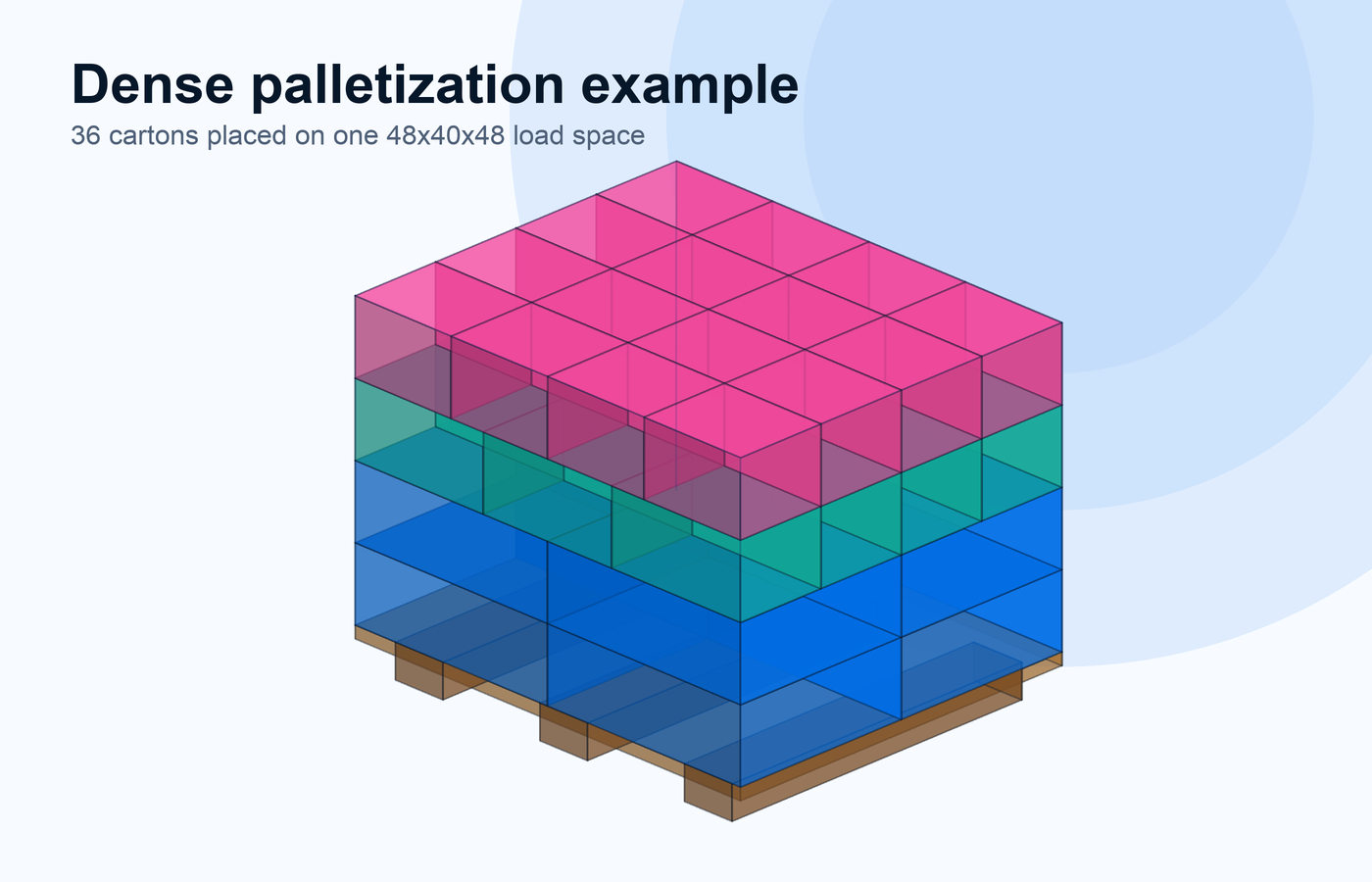
Loading identical cartons onto a pallet is often straightforward. Loading different-sized cartons is harder: every placement changes the space available for the next box, and rotating one carton can affect the entire arrangement.
This is the mixed-case palletization problem. Warehouses, fulfillment operations, manufacturers, and logistics teams encounter it when they need to consolidate cartons with different dimensions onto a limited pallet footprint.
A practical way to explore possible arrangements is to represent each carton by its dimensions, specify the usable pallet space, and use a 3D palletization solver to generate a candidate layout. You can then inspect the arrangement in three dimensions instead of relying entirely on trial and error.
What is palletization?
Palletization is the process of arranging goods on a pallet for storage, handling, or shipment. A pallet creates a standardized base that can be moved with suitable material-handling equipment.
In single-SKU palletization, a load often contains cartons with the same dimensions. Repeating a consistent stacking pattern can make layout planning comparatively simple.
In mixed-case palletization, cartons have different dimensions, quantities, and potentially different handling requirements. One carton may fit neatly into a gap; another may require an entirely different orientation. A layout that looks efficient from above may waste substantial vertical space.
How palletization relates to 3D bin packing
A simplified palletization problem can be modeled as a form of three-dimensional bin packing:
- The bin is the usable three-dimensional loading region above the pallet.
- The items are rectangular cartons defined by length, width, and height.
- A placement assigns each carton a position and an allowed orientation inside that region.
- A valid geometric arrangement keeps boxes inside the allowed space and prevents them from overlapping.
Depending on the business objective, you might want to fit as many cartons as possible on one pallet, reduce unused space, or use fewer pallets for a complete order. These are related objectives, but they are not identical.
3D bin packing is computationally difficult in general. Rather than guaranteeing the mathematically best layout for every possible order, practical solvers search for useful arrangements in a reasonable amount of time.
Importantly, a geometric packing plan is not automatically a safe physical load. Real shipments can also require checks for support, weight distribution, load-bearing strength, wrap or strapping, allowable overhang, and handling conditions.
What information do you need to plan a pallet load?
1. Pallet dimensions and height limit
Specify the usable loading length, width, and height. For example, a commonly used North American pallet footprint is 48 x 40 inches. The maximum permissible load height depends on your operation and equipment.
Be explicit about whether height means carton stack height above the pallet deck or total loaded height including the pallet itself. The example below uses the available carton stack height; if your overall height limit includes the pallet, subtract the actual pallet thickness first.
2. Carton dimensions and quantities
For each carton type, record its length, width, height, and quantity. Keep units consistent across every entry.
3. Allowed orientations
Some cartons can be placed on different faces. Others must stay right-side up because of product requirements, packaging, labels, or handling instructions. In NpSolv, the Keep Upright setting keeps the carton upright; selecting No allows vertical rotation when packing.
4. Real-world constraints
For physical shipping, dimensions are only the beginning. Carton weight, compression strength, support from cartons below, center of gravity, load restraint, and facility handling limits can all matter. Do not assume a geometric palletizer validates these requirements unless it explicitly provides those checks.
Worked example: loading three different carton sizes
Suppose you have a pallet with a usable loading space of 48 x 40 x 48 inches. You need to arrange three types of cartons:
| Carton | Dimensions (inches) | Quantity | Must remain upright? |
|---|---|---|---|
| A | 24 x 20 x 12 | 8 | Yes |
| B | 16 x 10 x 12 | 12 | Yes |
| C | 12 x 10 x 12 | 16 | Yes |
This link loads the example dimensions and quantities into the palletizer. It does not run the solver until you click Solve.
There are 36 cartons in the order. The total requested carton volume is:
8 x (24 x 20 x 12) + 12 x (16 x 10 x 12) + 16 x (12 x 10 x 12) = 92,160 cubic inchesThe available rectangular loading volume is:
48 x 40 x 48 = 92,160 cubic inchesIf every carton fits, the cartons occupy 100% of that rectangular volume. This example is deliberately dense, but volume alone still does not establish that every carton can be placed. Dimensions, orientations, and the sequence of placements matter.
How to plan a mixed-case pallet layout
Step 1: Define the usable pallet space
Enter the permitted length, width, and load height. Check for operational restrictions such as clearance limits or customer requirements before treating the dimensions as final.
Step 2: Enter the carton inventory
Add each box size and the number of cartons. If you are working from a warehouse export or spreadsheet, use a CSV workflow when your tool supports it.
Step 3: Specify orientation restrictions
Mark cartons that must remain upright. Rotation can make a big difference to geometric packing, but only rotations permitted by the product and the solver should be considered.
Step 4: Generate and inspect a candidate layout
Run the palletizer and examine the resulting 3D visualization. Look for large gaps, unexpected box orientations, and any cartons that remain unplaced.
Step 5: Validate the physical loading plan
Before using a candidate arrangement in a warehouse, check the constraints that a basic geometric model may not cover: load-bearing strength, support and stability, maximum pallet weight, restraint, equipment limits, and handling rules.
How do you measure pallet space utilization?
A simple geometric measure is volume utilization:
Volume utilization = volume of placed cartons / usable loading volume x 100%
Use the volume of placed cartons, not all requested cartons, when reporting achieved utilization. Record the number and volume of unplaced items separately.
Volume utilization can help compare geometric layouts, but it does not measure load safety, labor required to build the pallet, damage risk, or freight cost on its own.
Why are mixed-size pallets difficult to optimize?
There is no single ordering or rotation rule that works best for every combination of cartons. A large carton placed early may provide a convenient footprint but block smaller items from fitting later. Packing the small cartons first may fill gaps yet leave no suitable region for a large carton.
- Combinatorial choices: Many items can be placed in different positions and orientations.
- Geometric interactions: A placement affects which free spaces remain available for subsequent cartons.
- Operational restrictions: Keeping cartons upright, limiting stack height, and enforcing physical safety requirements further narrows feasible choices.
Practical solvers manage these tradeoffs by applying efficient placement and ordering strategies. They may generate useful layouts quickly, but a generated result is not necessarily optimal, and failing to place an item does not prove no feasible arrangement exists.
When should you use a palletization solver?
A geometric palletizer is particularly useful when you need to explore a mixed assortment of cartons, compare candidate arrangements, understand whether a proposed carton mix fits in a given loading envelope, or visually explain a plan before attempting a physical load.
NpSolv provides a palletization tool where you can enter carton and pallet dimensions, apply the available orientation options, generate a candidate arrangement, and inspect the returned placement data and 3D visualization. Treat the result as a candidate geometric arrangement, not a certified shipping or stability plan.
Try the 3D PalletizerFrequently asked questions
What is mixed-case palletization?
Mixed-case palletization means building a pallet with cartons of different dimensions or products instead of using just one repeated carton size.
Is palletization the same as 3D bin packing?
Not exactly. 3D bin packing is a mathematical model for arranging items within three-dimensional containers. Palletization is a real-world loading process that can be modeled using 3D bin packing but may require additional physical and operational constraints.
Can a 3D palletizer guarantee the best arrangement?
Not necessarily. Many palletization tools produce candidate layouts without proving those layouts are globally optimal.
Does a space-efficient pallet mean it is safe to ship?
No. Geometric fit does not by itself establish stability, load-bearing capacity, weight distribution, restraint, or safe handling.
Can I rotate cartons when stacking a pallet?
Only when the product and its packaging allow it. Some cartons may rotate on the pallet surface while remaining upright; others require stricter orientation rules.
What does pallet utilization percentage mean?
In a geometric model, volume utilization is the total volume of cartons successfully placed divided by the usable rectangular loading volume. It indicates how much modeled space is occupied, not whether the load is safe or operationally efficient.
Further reading: Silvano Martello, David Pisinger, and Daniele Vigo, The Three-Dimensional Bin Packing Problem, Operations Research 48(2), 2000.